How much planning (or lack thereof) are you comfortable with?
I know people who just show up someplace and wing it. (I’ve done that. I’m assuming that’s not you or you wouldn’t be here.) I also know people who schedule every minute of every day. (Not me. This post might get you part of the way there.)
We’re somewhere in between. Because — Libra and Pisces here — we sometimes struggle with decision-making. (We went to an all-inclusive resort on our honeymoon specifically to avoid decisions.) I’d also rather not spend valuable time on vacation finding a place to sleep, figuring out how to get around, debating where to eat, and waiting in line to buy tickets. I want to be enjoying where I’m at.
For more about us and how we travel, see About Us.
Step 1: Decide where to go
Before you buy plane tickets or book that lovely Italian villa, you kinda need an idea of where you want to go, when, and for how long.
Someone asked me once how we decide where to go. Which made me think: How do we decide?
For us it kind of goes like this:
WHEN are we taking this trip?
Lots of planning advice starts with where you want to go. I start with when.
We don’t travel during the summer:
- Summer is when people with kids travel, which means larger crowds and higher prices.
- It’s the only time the weather is reliably good at the family cottage, so we go there.
- We like gardening (I blog about that here), and there’s lots to do in the garden then.
We try to travel during shoulder season, when the weather is still decent but crowds are smaller and prices lower. Since shoulder season varies from one destination to the next, knowing when we plan to go is an important factor in where we go. (We also travel in winter to avoid winter. Sometimes you just can’t avoid high season. That means peak prices but at least we avoid snow!)
WHY are we going on this trip?
Back when I had a high-stress job sometimes I just wanted to get away and relax. Sometimes we really want to go somewhere new and different. Sometimes we just want better weather than we have at home.
HOW do we want to spend our time?
We enjoy outdoorsy things like hiking, snorkeling, wildlife, and hanging out at the beach. We also like more urban activities like wandering around cities and towns, visiting museums and cultural sites, and botanical gardens. Sometimes we want more wild and natural, sometimes urban and cultural. Often a mix of the two.
WHAT constraints do we have?
Time and budget are the most common constraints.
Now that we’re retired our travels are no longer constrained by work schedules or available vacation time (yay). Even when we were still working we went on fewer two week trips rather than more frequent shorter jaunts. We try to go for at least four weeks because:
- If it takes a long time to get somewhere, we want to make the most of our time while we’re there.
- On a short vacation, even one day of bad weather can wreak havoc. More time means greater flexibility and less pressure to do something right now even if it’s raining or we want to relax.
- Fewer, longer trips are more cost effective and better for the environment.
- We like to slow down and enjoy daily life, not frantically hop from one must-see to the next.
I know it’s hard – so much to see! so little time! – but try to resist the temptation to pack too much in too little time. Leave yourself time to breathe and absorb.
Is budget a consideration? Again, we’re retired so our budget is never going to increase. If you only have so much money to spend on a trip, that may influence where you go.
Now, WHERE do we want to go?
We have a list of places we might want to visit, or revisit, organized by which season is best for that location. Reviewing that list based on the answers to the above questions narrows down our options for our next trip.
For example:
- If we’re going in winter or spring and want to spend time snorkeling and hanging out at the beach, with maybe some hiking thrown in, we might go to the Caribbean. But we wouldn’t plan that trip for the fall (hurricane season).
- If we’re going in the fall and want to mix some beach time with historical and cultural sites, we might choose Greece or Spain. In winter or spring, it might be too chilly for swimming, but still good for sightseeing, and maybe some hiking.
At the end of this phase:
I have a location, a time of year, and a rough length of time.
For example: France for 4 weeks in the spring.
I’ll continue to use this example in this post.
Step 2: Research and explore
With the above defined (say, France in the spring for about 4 weeks), it’s time for research. I start with a guidebook if I can find a good one. We often already have an idea of some things to see or do — or we wouldn’t be looking at that location! — but I learn more once I start researching. I know there’s a lot of information for free online — like on blogs like this one — and I’ll end up there; I find it handy to have a comprehensive guide to start with.
GUIDEBOOKS
Lonely Planet and Rough Guides used to be my go-tos. Lonely Planet has changed format recently and the new guides are pretty useless, so I no longer use them unless I can find (or still have) an older version.
I’ve used Rick Steves for Europe recently but have to supplement them because they don’t cover everywhere we want to go. The areas they do cover they cover well, and I like the introductory walks they include for most destinations.
We mention any guidebook(s) we used in the Resources for each trip, along with any significant online sources I can remember.
I used to buy physical books. (After all, that was once the only option! Maybe that’s one reason I like guidebooks: When I planned my first major trip in 1983 there was no “online.”) Lately I’ve migrated to ebooks because they’re more portable.
For travel planning I prefer something like the Kindle Fire or an iPad:
- the photos and maps are in color
- the maps are easier to read and to expand
- the links work
- you can highlight like you would in a physical book
I use a different color for each category: Sights/Activities, Lodging, Food & Beverage, Notes. I usually export the highlighted items to a spreadsheet so I can sort and filter but I’m nerdy that way.
This is kind of the brainstorming phase. While I start with a guidebook, that usually leads to links for different websites, which in turn leads to other sites …
At the end of this phase:
I have a collection of possible destinations with possible things to see and do at each stop.
For France that included Normandy, the Loire, the Dordogne, Provence, the French Riviera, Paris, and maybe Strasbourg, the Atlantic Coast, or the French Alps.
Step 3: Outline the itinerary
Now that I have an idea of the things that we could see and do, I start narrowing it down to what we reasonably can see and do in the time available when we plan to go.
With a pretty good idea of must-dos and like-to-dos, I start building out an itinerary. My goal is to figure out:
- Which places to visit
- How much time to spend in each place
- In which order to visit them
For our trip to France, I started by eliminating the Atlantic coast and the Alps because it would be awkward weather for the beach or the mountains.
I then jot down what we might do on a given day in a spreadsheet. My goal is not to create an agenda for every day but to group sights and activities based on proximity and time needed. A spreadsheet keeps it compact so I can see the whole trip and move things around easily. I use Google Sheets because it’s highly portable; I can view and edit from anywhere — even my phone if necessary — and later use it as a reference while we’re traveling.
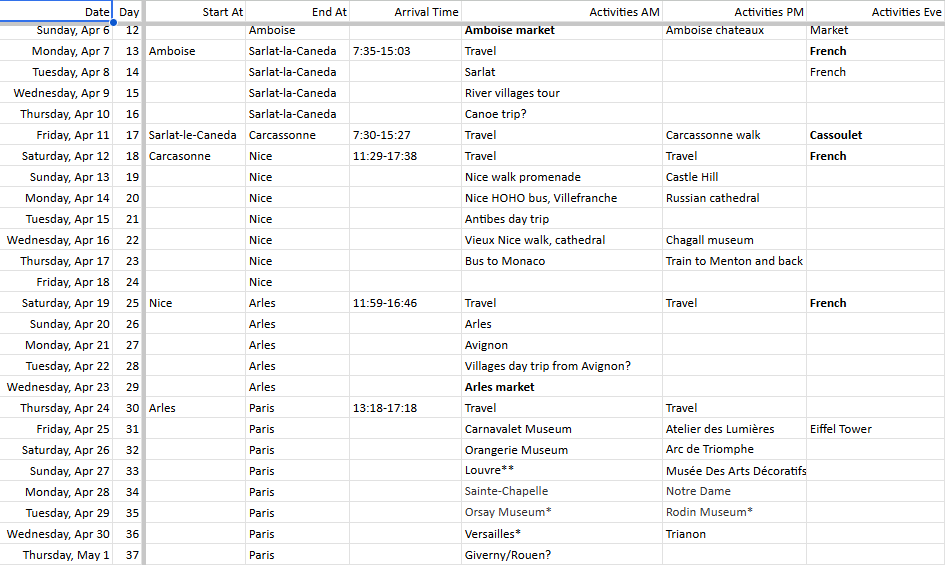
A benefit of this method is that we can adjust the itinerary on the fly as needed:
- On our first trip to Hawaii we dealt with both a nasty sinus infection and record rain and flooding, which led to leaving out and/or rearranging some of the things we’d planned.
- In Japan we rearranged days to account for a museum closure that I hadn’t noted and an activity we didn’t find out about until we got there. (Elvis impersonators, anyone?)
Tips:
- If something is a must-do, don’t leave it until the end. One reason we’ve been to Costa Rica multiple times is because we missed out on Corcovado National Park our first time because they canceled all the boats due to high seas the day we planned to go. When we went the second time we planned that for our first day in the area, not our last.
- Don’t forget to plan for getting from place to place, and to allow time for that. (This is easier if you’re driving, which we usually aren’t.) Checking train, bus, and ferry schedules can save on backtracking and wasting time in transit. I allow at least a half-day to move from one location to the next, by the time you pack up, switch places, check in, and resettle. Often it’s more like a whole day.
- Most itineraries I see start with the biggest bang first, for example Paris. Do you really want to be in Paris when you’re tired because you couldn’t sleep on the plane and you’re jetlagged? I like to start a trip with a place that’s interesting but doesn’t have a lot of must-sees, so we can feel free to take a nap without worrying about missing something. I put the big bang at the end of the trip, when we’re more used to the culture.
At the end of this phase:
- I know how many nights we’ll spend at each destination
- I know what we’ll likely do at each destination
- I know in which order to visit them, and how we’ll get from point to point
- I know how long the whole trip will be
I think of this as plotting the storyline of the trip. I like to be finished with this phase at least 6-8 months out. At this point I’m ready to start booking things and actually commit to dates.
This is the level of detail you see for upcoming trips in this blog.